Dr Francisco J. Abellán
Refractive surgery in Madrid: LASIK, PRK and phakic ICL lenses
Assessment of prescription, cornea and the rest of the eye to decide whether surgery is appropriate and which technique may fit.
Ophthalmologist · Medical registration no. 282880215
Trained at Hospital Universitario de La Princesa
- 1Prescription
- 2Corneal topography
- 3Ocular surface
The practice secretary manages administrative information and private appointments.
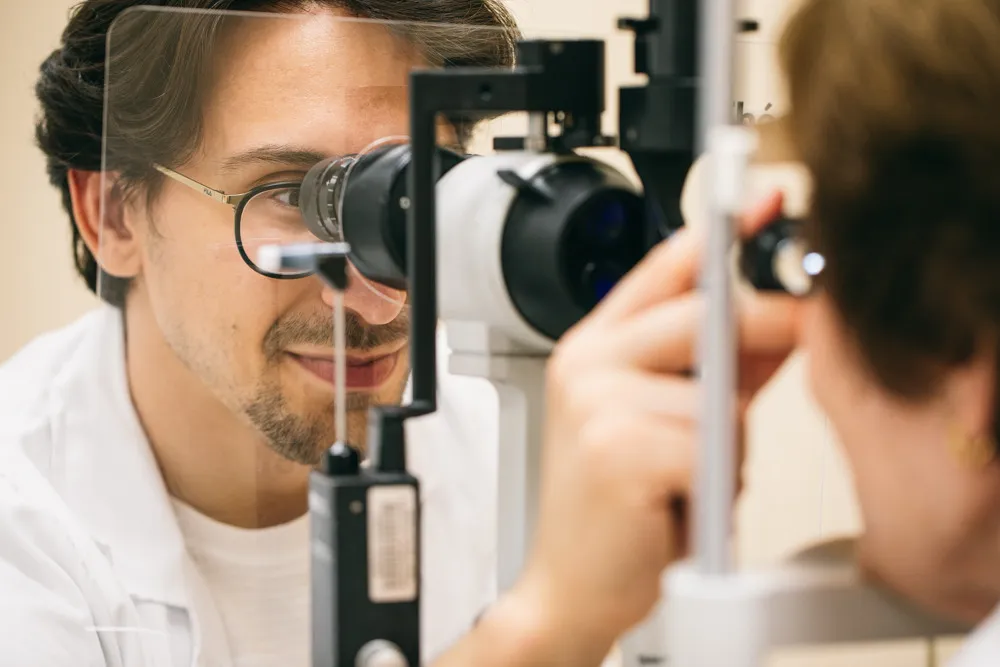
Questions the assessment answers
The eye is assessed first; a technique is chosen—or ruled out—afterwards.
Is the prescription stable?
LASIK, PRK or a phakic ICL lens?
Are the cornea and ocular surface suitable?
When might glasses still be useful?
Candidacy assessment
Surgery may be postponed or ruled out when findings are unfavourable.
Prescription
Magnitude, stability and visual goal.
Corneal topography
Shape, regularity and corneal thickness.
Ocular surface
Tear film, lids and dry-eye symptoms.
Quality of vision
Pupil, night vision and pre-existing halos.
Lens and retina
These may change the indication.
Expectations
Driving, sport, reading and possible use of glasses.
Interactive 3D model
PRK · corneal surface
The epithelium is removed and the laser reshapes the first microns of the anterior stroma. No flap is created: the epithelium regenerates over the new curvature.
Drag to rotate the model; the mouse wheel keeps scrolling the page.
Techniques and alternatives
No technique is best for every patient.
LASIK
Laser beneath a corneal flap; usually faster visual recovery.
PRK
Surface laser; no flap and a more gradual early recovery.
Phakic ICL lens
An intraocular lens that preserves the natural lens and requires suitable anatomy.
No surgery
Glasses, contact lenses or prior ocular-surface treatment remain options.
Refractive surgery in 3D
PRK, LASIK and the phakic ICL lens, explored step by step on the same three-dimensional eye.
Frequently asked questions about refractive surgery
How do I know whether I am suitable?
Suitability requires review of prescription, stability, cornea, ocular surface, crystalline lens, retina and your needs. The dioptre value alone cannot select a technique.
LASIK or PRK?
This depends on corneal thickness and shape, prescription, ocular surface, work and sport, among other factors. LASIK often recovers faster; PRK avoids a flap but has a more gradual early recovery.
What is a phakic ICL lens?
It is a lens implanted inside the eye without removing the crystalline lens. It may be an option for selected prescriptions or corneas, but carries intraocular-surgery risks and needs ongoing checks.
Will I be completely free from glasses?
Dependence can be reduced substantially, but nobody can guarantee that glasses will never be useful. The result depends on the eye, healing, the agreed target and changes with age.
Authorship, medical review and sources
- Author and medical reviewer
- Dr. Francisco Javier Abellán Martínez
- Ophthalmologist · Medical registration no. 282880215
- The same specialist currently authors and medically reviews the content; this is not presented as an independent external review.
- Last medically reviewed
Sources consulted (2)
- Refractive surgery patient information (Opens in a new tab)The Royal College of Ophthalmologists
- Refractive surgery standards and guidance (Opens in a new tab)The Royal College of Ophthalmologists
General educational content. It does not replace an individual assessment, diagnosis or personalised instructions from your healthcare team.
How these guides are written and reviewedRefractive surgery assessment in Madrid
Private consultation at Centro de Especialidades Clara del Rey, Hospital Quirónsalud San José. The first decision is whether surgery is advisable; technique selection follows the examination.
WhatsApp and phone are administrative channels. They do not replace a consultation, cannot manage emergencies and should not be used to send sensitive clinical information.
Related information