Dr Francisco J. Abellán
Cataract surgery in Madrid: a patient guide
Ophthalmologist · Medical registration no. 282880215
Trained at Hospital Universitario de La Princesa
- 1Confirm the cause
- 2Study your eye
- 3Choose the plan
The practice secretary manages information and private appointments.
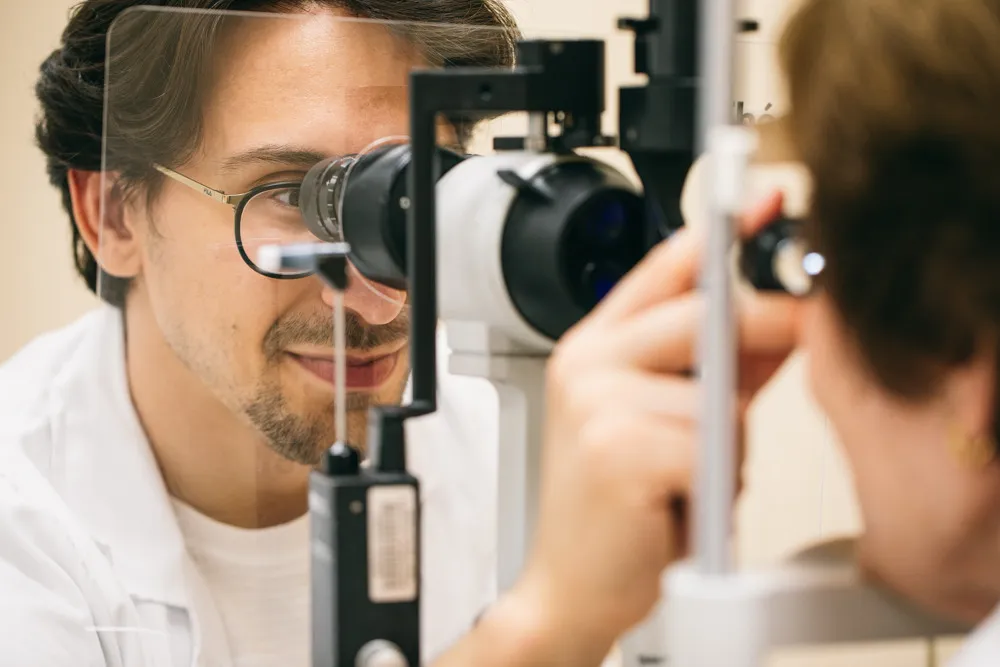
Do I need cataract surgery?
- 1We listen: symptoms and their impact on reading, driving or work.
- 2We examine: visual function and the health of the whole eye.
- 3We decide together: expected benefit, limitations and individual risks.
Monitor
If the limitation is mild or surgery is not the best option yet.
Plan surgery
If the cataract explains the difficulty and the expected balance is favourable.
Before your assessment
Contact lenses may need to be stopped before measurements. Pupils are dilated, so come accompanied and do not drive afterwards.
What cataract surgery is usually like
The exact plan depends on your eye, your health and the centre’s protocol.
- Is it an outpatient procedure?
- Usually yes, no overnight stayUsually outpatient, without an overnight stay.
- What anaesthesia is used?
- Tailored to your caseThe technique is selected for your eye, health and centre protocol.
- How long does it take?
- Usually briefUsually brief; the full stay includes preparation and discharge checks.
- Do I go home the same day?
- In most casesIn most cases, after the appropriate checks and with the indicated accompaniment.
Four stages, one coordinated pathway
Plan
Assessment, measurements and shared choice of lens and refractive target.
Prepare
The centre confirms the date and gives individual medication and fasting instructions.
Operate and discharge
The cloudy lens is removed and the planned lens implanted; discharge instructions are provided.
Review
Recovery, eye pressure and visual result are checked according to your schedule.
The cloudy lens is removed and a new lens takes its place
The operation replaces the cloudy natural lens with an intraocular lens through a small incision.
Moderate cataract
The clouding advances: colours lose vividness and reading or night driving becomes harder.
Drag to rotate the model · tap a structure to identify it
- 01Where the cataract sits
Inside the eye, just behind the pupil
The natural lens is just behind the pupil.
- 02How it is removed
With ultrasound, through a small incision
Ultrasound fragments and removes the cloudy lens.
- 03What stays inside
A permanent lens in the same place
The calculated intraocular lens is placed in the lens capsule.
Illustrative 3D model for information purposes. It does not represent the outcome of any particular case, nor does it replace the assessment, diagnosis or individual instructions of your healthcare team.
New · 3D journey
The cataract, seen from the inside
A two-minute journey driven by your scroll: from the healthy eye to the intraocular lens, with a free mode to explore the eye.
View the 3D journeyThe lens is chosen after the examination, not from a catalogue
This comparison is orientative: no single design is best for every eye or every person.
Toric. Corrects suitable corneal astigmatism when measurements support it.
Criteria used to discuss the lens
- Cornea and astigmatism
- Retina, optic nerve and glaucoma
- Previous eye surgery
- Activities, night driving and glasses
Why consult Dr Abellán?
An honest indication. A cataract does not automatically mean surgery.
A lens chosen after the study. The lens is discussed after examining your eye and priorities.
Clinical training and experience. Training at La Princesa, with public and private clinical practice.
Continuity of care. You will know who is responsible for each stage before scheduling.
Cost, insurers and cover
The assessment defines the lens, available cover and final budget.
- 1/3
Selected lens
Defined after the preoperative study.
- 2/3
Insurance cover
Checked case by case before scheduling.
- 3/3
No medical insurance
The secretary explains the assessment cost and available options.
Reviews on Google
To keep reviews verifiable and up to date, patient reviews are viewed and published exclusively on the official Google profile.
Frequently asked questions about cataract surgery
Does cataract surgery hurt?
The anaesthetic plan aims to keep you comfortable. Tell the team if you feel discomfort so they can assess it.
What anaesthesia is used?
It is chosen for your eye, health and the centre’s protocol. You will receive individual instructions.
Read the preoperative preparation guideHow long does the procedure take?
The operation is usually brief; the full stay also includes preparation and discharge checks.
Do I go home on the same day?
In most cases, you return home after the relevant checks. Follow the centre’s transport and accompaniment instructions.
When will my vision begin to improve?
Some people improve early; vision may remain blurred or fluctuate at first. Reviews assess your individual progress.
Read the postoperative care guideWhen can I drive or return to work?
It depends on your vision, work and recovery. Do not drive until your clinical team confirms it is appropriate.
Check the recovery and activity guidanceAuthorship, medical review and sources
- Author and medical reviewer
- Dr. Francisco Javier Abellán Martínez
- Ophthalmologist · Medical registration no. 282880215
- The same specialist currently authors and medically reviews the content; this is not presented as an independent external review.
- Last medically reviewed
Sources consulted (4)
- ESCRS recommendations for cataract surgery (Opens in a new tab)European Society of Cataract and Refractive Surgeons (ESCRS)
- Cataracts in adults: management (NG77) (Opens in a new tab)National Institute for Health and Care Excellence (NICE)
- Cataract surgery: procedure and recovery (Opens in a new tab)National Health Service (NHS)
- Patient information booklets (Opens in a new tab)The Royal College of Ophthalmologists
General educational content. It does not replace an individual assessment, diagnosis or personalised instructions from your healthcare team.
How these guides are written and reviewedRequest a cataract assessment in Madrid
The practice secretary can provide administrative information about the private pathway and arrange an assessment.
The practice secretary manages information, insurers, administrative procedures and private appointments. This is not a medical-advice or emergency channel: do not send clinical reports, and use the emergency service or the channel indicated by your healthcare centre for urgent symptoms.